


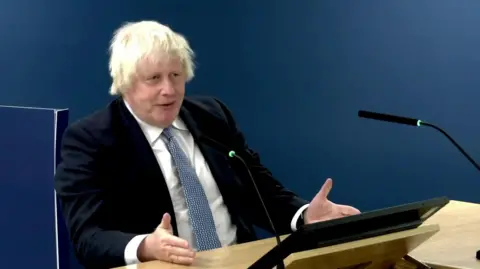
 Government Inquiry Session
Students paid a "huge toll" to safeguard society during the Covid crisis, Boris Johnson has informed the investigation studying the impact on children.
The ex- PM echoed an apology delivered earlier for things the authorities got wrong, but said he was pleased of what instructors and schools accomplished to deal with the "incredibly tough" situation.
He responded on prior suggestions that there had been insufficient strategy in place for closing learning institutions in the initial outbreak phase, stating he had presumed a "great deal of deliberation and planning" was already going into those choices.
But he explained he had furthermore wished learning facilities could stay open, labeling it a "dreadful idea" and "personal dread" to shut them.
Prior Statements
The investigation was told a strategy was just developed on the 17th of March 2020 - the date prior to an statement that educational institutions were closing.
The former leader told the inquiry on Tuesday that he acknowledged the concerns concerning the absence of strategy, but added that enacting adjustments to schools would have demanded a "significantly increased level of awareness about Covid and what was probable to happen".
"The speed at which the illness was advancing" complicated matters to plan regarding, he continued, saying the key emphasis was on trying to prevent an "devastating medical crisis".
Disagreements and Assessment Results Disaster
The hearing has furthermore learned earlier about several disagreements involving government officials, for example over the decision to close schools a second time in the following year.
On that day, the former prime minister told the inquiry he had desired to see "widespread testing" in schools as a means of maintaining them open.
But that was "never going to be a viable solution" because of the new coronavirus variant which appeared at the concurrent moment and accelerated the transmission of the disease, he said.
One of the biggest issues of the crisis for all authorities occurred in the assessment grades crisis of the late summer of 2020.
The education authorities had been forced to go back on its application of an system to assign outcomes, which was intended to prevent elevated scores but which instead saw 40% of expected results lowered.
The general protest caused a reversal which meant pupils were finally given the scores they had been expected by their instructors, after GCSE and A-level assessments were scrapped beforehand in the period.
Thoughts and Prospective Crisis Planning
Referencing the tests fiasco, hearing counsel indicated to Johnson that "the entire situation was a catastrophe".
"If you mean was Covid a catastrophe? Yes. Did the deprivation of schooling a catastrophe? Yes. Did the cancellation of assessments a catastrophe? Absolutely. Were the frustrations, frustration, frustration of a significant portion of children - the additional disappointment - a disaster? Yes it was," Johnson stated.
"However it must be considered in the framework of us attempting to deal with a far larger catastrophe," he noted, mentioning the deprivation of learning and tests.
"Generally", he stated the education administration had done a quite "heroic work" of striving to deal with the crisis.
Subsequently in the day's proceedings, Johnson stated the restrictions and physical distancing guidelines "probably were excessive", and that children could have been exempted from them.
While "ideally this thing not occurs a second time", he said in any potential future outbreak the shutting of schools "truly ought to be a step of ultimate solution".
The current phase of the Covid inquiry, reviewing the consequences of the outbreak on youth and adolescents, is due to end in the coming days.


