

Until I was twelve years old, I was educated in the French school system, where theatre meant Molière, Corneille, Racine. Going to the theatre usually meant shows such as The Sound of Music or My Fair Lady. Then, a decision was made that I would switch to school in England. So, at age 13, I started at Westminster School. It was the late sixties, and the world opened up.
I went to see a school production of Waiting for Godot in French in a compact space with a modest platform, and I was sitting at the back. In terms of music, I was quite advanced – I was familiar with all the psychedelic music that had been emerging. I’d experienced the Mothers of Invention. I’d watched numerous performances. But I was unaware there was material of this kind. I quickly realized that, just like in music, there was a whole new world out there.
I am unsure how fluent the French was, but it wasn’t important what they were saying. It was just so conceptual and lively, with a kind of built-up suspense. And then, of course, it all explodes with Pozzo and Lucky’s arrival. The show was staged by older boys, including a talented actor as Lucky. He was such a presence on stage. And he has to deliver that extraordinarily baroque monologue. In French. It was amazing.
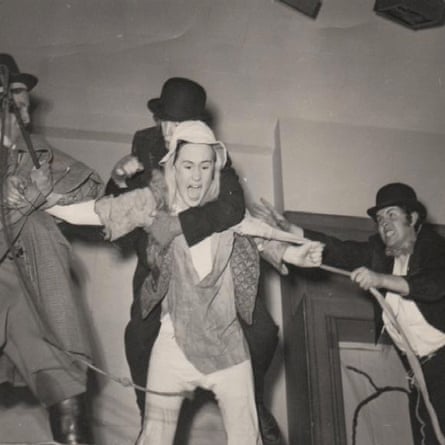
I loved the idea that nothing really had to happen, you know? That one thing happened and then it continues endlessly and then you have the young messenger at the end stating that Godot won’t be coming today. It addressed time and action and narrative. Or the lack thereof.
We had been taught all these rules about what drama was, but they were irrelevant here. I was absolutely fascinated by the minimal action. Years afterward when I was mixing records, I would attempt to transform them into something comparable. When a fresh sound came in, I’d pull out other instruments and deliberately isolate them. So you really heard that keyboard or that guitar or whatever it was. That sense of less is more … I grasped that with Godot.
And yet it possesses a narrative. It really does. I mean, they are well-developed personas. They are vibrant, the two protagonists, in their mutual affection, like an old married couple. I don’t know how my life would have turned out if I hadn’t gone that show. To that school and that play then. It just awakened something in me.
We were released on weekend days, and I started going afternoon shows at the theatre venue every time there was a fresh staging. So you would experience Pinter, John Osborne, Simon Gray plays. But the gateway to all of this was Godot.
I have minimal memory of the actual show, except I know that it was never boring – it had me at the height of anticipation. What I took away is that there don’t have to be any rules. It certainly shaped how I collaborated with the bands that I signed to my label. I even had the musical group compose a track around “I Can’t Go On, I’ll Go On”. I just told them: “I want a song with this title.”
I think it boosted my confidence, too, because you don’t need to worry about failure if you subscribe to Beckett’s worldview.


