


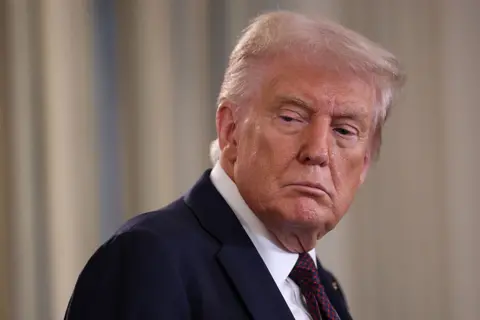
America's Supreme Court starts its latest docket starting Monday containing a agenda already loaded with likely significant disputes that may determine the limits of Donald Trump's executive power – plus the prospect of more issues approaching.
Throughout the recent period since Trump came back to the Oval Office, he has challenged the boundaries of presidential authority, solely enacting recent measures, reducing public funds and staff, and seeking to bring once independent agencies more directly under his control.
Judicial Battles Concerning Military Mobilization
The latest brewing court fight stems from the White House's moves to take control of local military forces and dispatch them in metropolitan regions where he alleges there is public unrest and escalating criminal activity – despite the objection of local and state officials.
In Oregon, a judicial officer has issued directives blocking the administration's mobilization of military personnel to the city. An appellate court is scheduled to reconsider the action in the next few days.
"Ours is a nation of constitutional law, not martial law," Magistrate the presiding judge, that the President appointed to the judiciary in his previous administration, wrote in her recent ruling.
"The administration have offered a range of arguments that, if accepted, endanger blurring the distinction between civilian and military government authority – to the detriment of this country."
Shadow Docket May Shape Defense Authority
When the higher court issues its ruling, the High Court could get involved via its often termed "expedited process", handing down a judgment that might restrict Trump's authority to deploy the armed forces on domestic grounds – or give him a free hand, at least temporarily.
This type of processes have grown into a more routine practice in recent times, as a majority of the judicial panel, in response to emergency petitions from the executive branch, has largely authorized the president's measures to proceed while legal challenges play out.
"A continuous conflict between the justices and the lower federal courts is poised to become a major influence in the upcoming session," an expert, a instructor at the Chicago law school, remarked at a briefing last month.
Objections Over Expedited Process
Judicial dependence on this shadow docket has been criticised by liberal experts and leaders as an unacceptable use of the judicial power. Its rulings have usually been short, providing minimal explanations and providing trial court judges with scarce guidance.
"All Americans should be alarmed by the High Court's growing dependence on its emergency docket to settle contentious and high-profile disputes without the usual transparency – minus comprehensive analysis, public hearings, or reasoning," Legislator Cory Booker of the state commented earlier this year.
"That additionally pushes the justices' considerations and rulings away from civil examination and insulates it from responsibility."
Full Proceedings Coming
Over the next term, though, the judiciary is set to tackle questions of presidential power – along with further notable disputes – directly, conducting courtroom discussions and issuing complete rulings on their merits.
"It's not going to have the option to short decisions that don't explain the reasoning," noted an academic, a professor at the Harvard University who focuses on the Supreme Court and American government. "If the justices are planning to award more power to the executive they're must justify why."
Key Matters within the Docket
Judicial body is currently set to consider the question of federal laws that forbid the chief executive from dismissing officials of agencies established by lawmakers to be autonomous from executive control undermine executive authority.
Court members will further consider appeals in an expedited review of Trump's bid to dismiss Lisa Cook from her post as a governor on the key monetary authority – a dispute that might substantially increase the chief executive's power over American economic policy.
The nation's – plus world economy – is further front and centre as Supreme Court justices will have a opportunity to decide if several of Trump's unilaterally imposed taxes on foreign imports have proper legal authority or must be invalidated.
Judicial panel could also review the administration's attempts to unilaterally cut public funds and terminate subordinate government employees, as well as his forceful migration and deportation measures.
While the justices has yet to consented to examine Trump's bid to terminate automatic citizenship for those delivered on {US soil|American territory|domestic grounds


