

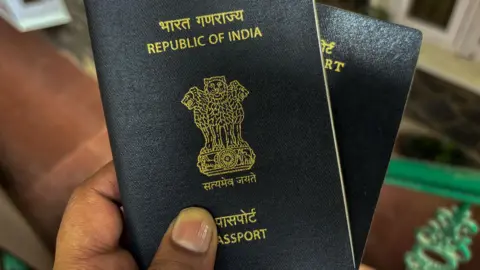
In recent months, an online clip from a popular travel content creator expressing frustration over the limited power of the Indian passport went viral across digital platforms.
He mentioned that while neighbouring countries like Bhutan and Sri Lanka offered easier access of Indian tourists, securing travel permits to travel to many nations in Europe and the West remained a challenge.
Such concerns regarding India's poor passport strength was reflected in recent Henley Passport Index, ranking the country at position eighty-five out of nearly two hundred nations, five spots lower compared to the previous year.
The Indian government have not issued a statement on the report yet.
Countries including Rwanda, Ghana and Azerbaijan with much smaller economies compared to India – which is the fifth-largest economy globally – are ranked higher in the ranking at the 78th, 74th and 72nd spots, respectively.
Actually, the country's position in the past decade has remained in the 80s, falling to the 90th spot two years ago. These rankings appear poor when measured against other Asian countries such as Japan, South Korea and Singapore, all maintaining top positions.
What Passport Strength Measures
The power of a passport reflects a country's global influence and global influence. It also translates into enhanced travel freedom for passport holders, improving commercial and educational prospects. A weak passport results in more paperwork, higher visa costs, fewer travel privileges and extended processing periods for travel.
However, even with the decline in the rank, the count of nations offering visa-free access to Indians has actually increased in the past decade or so.
As an instance, in 2014 – the year Prime Minister Narendra Modi's Bharatiya Janata Party (BJP) came to power – fifty-two nations provided visa-free access to Indians with the passport at seventy-sixth position on the index.
The following year, it tumbled to the 85th position, then rose to eightieth over the past two years, dropping again to the 85th position this year. At the same time, visa-free destinations to Indian citizens grew from fifty-two eight years ago to sixty last year and sixty-two this year.
The Competitive Global Mobility Landscape
The count of nations allowing visa-free entry in 2025 (fifty-seven) is higher than the number eight years ago (fifty-two), yet India's rank during both periods is 85. What explains this situation?
Experts say that a primary factor is the increasingly competitive landscape in global mobility – indicating that countries are entering into additional travel agreements to benefit their citizens and economic growth. According to a 2025 report, the worldwide mean number of destinations travellers are able to access without visas has almost doubled from fifty-eight nineteen years ago to one hundred nine currently.
For example, China has increased its count of visa-free countries its citizens can travel to from 50 to 82 over the last ten years. As a result, its rank in the ranking has enhanced from ninety-fourth to sixtieth in that same duration.
In comparison, India – previously positioned at seventy-seventh place in July – fell to the 85th position this autumn after losing access of two nations.
Other Influences Impacting Passport Power
An ex-diplomat from India says multiple elements influencing a nation's passport power, including its economic and political stability plus its receptiveness to accepting travelers from abroad.
For example, the US passport has dropped out of the top 10 currently holding the 12th position – its lowest ever – because of its increasingly insular stance in world politics.
The former ambassador recalls that during the seventies, Indians enjoyed visa-free travel to numerous European and Western nations, though this shifted after the Khalistan movement during the eighties. Later political disturbances have continued to damage the country's reputation as a stable, democratic country.
"Numerous nations are also becoming increasingly wary of immigrants," the diplomat added. "India has a large quantity of citizens emigrating overseas or overstaying their visas affecting the national image."
Factors such as how secure a country's passport is and immigration processes also contribute to obtaining visa-free access to foreign nations.
Enhanced Security Measures
India's passport faces ongoing security risks. Last year, authorities arrested 203 people for suspected visa and passport fraud. The country also has cumbersome immigration procedures and a slow pace of visa processing.
The diplomat indicated that new technologies, such as the newly introduced electronic passport or e-passport, may enhance safety and streamline immigration. The e-passport contains a small chip that stores biometric information, increasing difficulty to forge or tamper with the passport.
But, increased diplomatic efforts and travel agreements remain key for enhancing the global mobility of Indians and consequently, India's passport ranking.


